The Last Migration |
by Jad El Hage |
 |
| sections |
| Synopsis |
| Excerpts |
| Prologue |
|
Title Verso Published by Panache Publications |
| © Jad El Hage 2002 | -2026 |
As a correspondent he's travelled the world, worked as a reporter, features editor, broadcaster and TV presenter, living in France, Greece, England and Australia. He now divides his time between the north Lebanese village of Sereel and his family home in Melbourne.
" The Last Migration" is his first novel in English. It was launched in Sydney, Melbourne and Beirut.
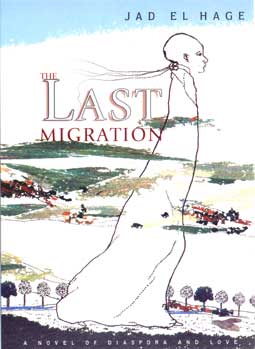
This 56,000 word novel tells the story of one momentous year in the life of Ashraf Saad, a fortysomething Lebanese journalist working for an Arab newspaper in Shepherds Bush. On one level it's a simple tale of love found and lost and found and lost and - perhaps - found again. But beneath its entertaining surface it portrays the bewildered restlessness of the Lebanese Diaspora, forced out of their deeply-loved homeland by the civil war of 1975-93. However successful and adaptable they may appear to be in their new countries they are profoundly aware of what has been lost - in Lebanon and in themselves.
The novel is in four parts.
Part One, CLAIRE, opens in April 1995, when Ashraf meets the love of his life while covering a pan-Arab cultural conference in Amsterdam. It's also love at first sight for Claire, a French writer now living in Amsterdam.
For the next few months they shuttle between London and Amsterdam, Venansault in France, Malta - anywhere their hectic schedules allow them to meet. Ashraf wants to take her to meet his mother, a nurse in their ancestral village of Cana, but the increasing shelling of south Lebanon - despite the civil war being over - prevents them.
During their last few days together, Claire tells him she'll be making a research trip to Mexico, soon. He wants to dissuade her but bows to her independence despite his foreboding. In the last chapter his foreboding proves all too justified. He's awakened from an ominous dream by a phone call from Françoise, Claire's grown up daughter, telling him that Claire is dead.
The title of Part Two, ADRIFT, signals the mental state of Ashraf as he stumbles through a series of situations characterising his now-shattered life. The assurance by his GP, Dr de Souza, that he is merely grieving and not "going crazy", is small comfort. His boss sends him to cover events in Dubai and Copenhagen and Morocco but his mind isn't on his work. Letters from his two teenage daughters in Australia tell him he's needed there, but the only job that can support them is in London.
Worse, the shelling of south Lebanon is escalating. During a nine-hour stopover in Beirut, Ashraf rushes to Cana for a moving reunion with his mother and to try to persuade her to leave. But she is the only medically-trained person left in the village and refuses to leave.
His life deteriorates still further when a pair of teenage yobs attack him on Halloween. The damaged shoulder that results gets worse as the novel progresses.
The only light relief comes from his old friend Anna, a jaunty streetwise plumber from Belfast who announces she's now going to belly dancing classes. She introduces him to her teacher, Jeanette, and he is briefly tempted by this beautiful Iraqi who lived in Beirut before the war and is one of the few people who might understand his complex feelings.
But woven through this section is his inconsolable grieving for Claire. In the penultimate chapter Françoise visits him during a stopover in London and gives him the notebook Claire wrote throughout their brief relationship. The last chapter is extracts from this book - love poems and lyrical descriptions of their time together - ending Part Two on a poignantly positive note.
In Part Two we met Ashraf's mother. Now we meet the third generation, the daughters he misses so much. Part Three, DOWNUNDER, is a relatively peaceful interlude - Ashraf's holiday in Australia with his daughters: Layla, eighteen, is sensitive, practical, mature beyond her years, because of having to be a proxy parent to her younger sister. Reem, at thirteen, is multitalented but demanding: affectionate, spoilt, volatile, she keeps them on the hop during a four-day spell of appalling weather that confines them indoors. ("Hurricane Reem")
But there are good days, too: on the beach and visiting another Lebanese immigrant family on their farm, giving us more insight into the Diaspora. We also discover the story of Ashraf's marriage and divorce.
On his last morning, he sees the sandals Claire bought him in Amsterdam and realises that being with his daughters has brought about a slight shift in his mourning. He vows to be more positive from now on.
Part Four, JENNY, introduces the second love affair of the book.
On his return from Oz, a pink business card among his post advertises the services of Jenny Grant: reflexology and massage. His shoulder is still hurting, so he decides to give it a try. He's intrigued by this pretty and practical Scottish lass and after three treatments asks her out to dinner.
Soon they are lovers. But right from the start there are cracks in the relationship. He takes Jenny, an amateur potter, to spend the day with the well-known Yemeni potter Abdo Nagi, now living in Letchworth. Her interest in Middle-Eastern culture stops well short of joining in the informal belly-dancing at this family gathering. A car boot sale brings out her emphasis on money and material goods. TV coverage of yet more serious shelling near Cana shows her simple-minded response to Ashraf's fears for his mother.
Something is wrong with their relationship. When he finds a box of condoms in her bedside table (they never use condoms), he thinks he's found the answer. And during a weekend at a mysterious "friend's" cottage in Cornwall, his worst fears seem to be justified.
One evening he has a surprise visit from Sami, his childhood friend, on a stopover to Tokyo. During an evening of drinking arak and reminiscing, Ashraf suddenly blacks out. A phone call to Dr de Souza appears reassuring enough.
Jenny's birthday begins the climax of the novel. Ashraf is making an extravagant last-ditch effort to prevent Jenny from drifting out of his life. It backfires. He is forced to acknowledge that Jenny is incapable of love, that his efforts to "love enough for two" haven't worked. After a wild drive around London, he calms down enough to return to the Bush. He wakes Jenny, cedes defeat and gives back her keys.
But he's too disturbed to go home. He drives to his office which he's neglected so long he's in danger of losing his job as well as his love. There he finds a letter from his mother which has been brought out by the Red Cross. Conditions in Cana are critical. It looks like he might be losing his mother, too.
He goes home at last and begins a frenzied packing, as if it were he who was fleeing Cana. Then he thinks to phone Anna, the only stable point in his disintegrating life. He goes to her house and collapses.
The next morning, 19 April 1996, Anna's voice - "Get your ass over here" - brings him to her TV on which news of the notorious massacre at Cana is being announced. Over a hundred civilians sheltering in the UN compound have been killed by a bomb. Ashraf's mother was in that compound.
They rush to the Lebanese embassy. Ashraf is weak with fear listening to the list of the dead, many of them friends and relatives. Finally a Lebanese colleague brings him a telegram. His mother is safe and is admitting defeat.
[p.p. 32-33]
Ya dara douri fina, dalli douri fina, we all sang together with Feyrouz. Layla was doing well at uni. She was majoring in history. Reem thought her sister was born to teach history. "She remembers names and dates and battles and catastrophes like nobody does, Dad." Reem, however, hated school. "It's hard." She just wanted to sing and dance and act and be rich and famous, yesterday.
"How about you, Dad?" Layla asked. "Are things any better now?"
"A little. Not much." It was difficult to know how much to say. I didn't want to burden them with my grief but at the same time didn't want to exclude them from my feelings. So I talked, carefully, sharing with them some of the more light-hearted times Claire and I had had. Like how keen she was to learn the words of Ya dara douri and how I taught her to write her name in Arabic, just before she left for Mexico.
"I've always wondered," Layla mused, "why Arabic is written from right to left."
I gave her the answer that had amused Claire. "Maybe because Arabs think towards the heart. When you write from right to left," I said, demonstrating with Reem's arm, moving it from around my neck, "you bring your audience into you. When you do it the other way, you take yourself to them."
Layla raised an eyebrow at this bit of home-made philosophy.
Reem gave me a long hug from the back seat.
--------------
[p. 34]
The moon was the only neighbour to see us. We forgot to be tired until much later. It was so difficult to close my eyes when what they had missed for so long was finally dancing in front of them. Music is magic, with the power of awakening cultural genes. Here were two western girls in every other aspect of life – Layla still spoke some Arabic but Reem none – both brought up in Australia, and yet when they hear this music their bodies respond as if they'd been reared in Cana.
I remembered an article I'd written at Claire's instigation, about the comparative politics of immigration. She had found a report by a group of French parliamentarians listing more than forty repressive measures to halt illegal immigration: fingerprinting all visitors, keeping them in restricted areas, denying them medical treatment and denying their children an education. It sent me questioning the descendants of the French Revolution and whether Liberty, Equality and Fraternity were made in France, for the French only, and may all other wretched creatures rot in hell. France had refused us visas at the beginning of the civil war even though my father had served with the French navy and Lebanon was a Francophone country. But halfway around the world, Australia took me and my family when we had nowhere to go.
And here was the result of that Australian generosity: my two beautiful daughters, unscathed by war, bringing blessed peace to my grieving spirit.
--------------
[p.p. 63-64-65-66]
The conference was duty, the imprompyu interview with Nasri a bonus, but the real reward for this extended return to London was the nine - hour stopover in Beirut. I'd wanted so much to come with Claire, not to Beirut-our capital had been smashed beyond recognition-but to Cana. At one stage I even suggested Françoise could come too. Claire wouldn't hear of it. "I don't mind putting my life in danger to be with you but not Francoise's. No way. " We'd had this discussion when we met in Paris on our way to Venansault. "This time your birthplace, next time mine, " I said.
The screechy bumpy landing shook us and didn't provoke the usual applause. Nor was there much to clap for. Glamourous Beirut - Sur - Mer, disfigured by a leprosy of tin roofs and cement blocks. Crumbling shacks invading one of the best stretches of the Mediterranenan, crawling their way to the tarmac. Most of us aboard were expats, once cast out under intense pressure, now reeled back in by different pressing matters. We shuffled to the terminal, brooding, responding grudgingly to the grinning faces of the outbound passengers.
It hurt.
It hurt even more when we were curtly checked by a bunch of uniformed yobs sporting machine guns and insolent eyes. An intimidating foretaste of life in Beirut. It robbed me of the ancestral impulse to bend and kiss the soil.
" You live in London? "
" Yes. "
" Anything to declare? "
" I declare that I am here in transit. Few hours only. "
" You're not happy to be back? "
At my silence the questions came to an abrupt halt.
" Go. "
The taxi driver, an old southerner himself, couldn't understand why I wanted to head south. Everyone else was fleeing the south. The south was a bleeding wound. To be avoided, unless one was desperate or suicidal. "Don't you read the papers? " Soon he was prodding me as if I was family. Why didn't my mother come to meet me at the airport? In Tyre? Or Sidon? Why Cana? It's become a front-line. He wasn't trying to make me change my mind, nor was he afraid. He had spent the war years taxiing people in and out of death's jaws.
How could I explain?
I hadn't seen my mother in two years. At the beginning of the civil war she'd urged me to leave the country: "Son, you don't belong here. Take your wife and your daughter out, I don't wish to become the mother of a martyr. " Beirut was in flames. I was there, working for a newspaper. Layla was a toddler, and Sabina was teaching in Cana. Cana was bad too. It was nerve-wracking to think of them there. Mother was right, but I still wished she had left with us. Now I wasn't sure which one was stronger: my fear of losing her, or my missing her. Some confusion to explain to a stranger.
We drove through Ouzai. Once a pearl, now a string of eyesores, an overcrowded shantytown, mocking a bygone beauty. Thuds of shelling and their echoes drum-rolled our journey through the shacks and rubbish. Past larger-than-life cardboard politicians/clerics/martyrs. Under banners of dogmatic quotations. Past kitsch propaganda murals of Paradise promised, kalachnikovs simultaneously dripping blood and ejecting doves with laurel branches in their beaks. Through zonked-out jaywalkers crossing ruptured roads.
Between Sidon and Tyre I drew just enough oxygen from token patches of citrus and banana orchards salvaged to stand witness to what once was.
Uphill from Tyre to Cana we trailed behind a loaded truck. I expected my driver to mumble insults and watched for the first signs of impatience. But instead of overtaking he was coaxing its driver: "Come on brother, you're the big one, shield us from the shells. " Luckily the day was chilly. We closed the windows and sat on thirty kilometres per hour, breathing a cocktail of carbon monoxide and dusty ventilation, but shielded and safe. Memories sometimes silver-line the darkest clouds. Years ago this very truck would have been a playground for two boys on their bikes after a long day at the beach. Marwan and I would clutch the side of the truck and have an easy ride up the hill, all thirteen kilometres from Tyre to Cana. There's something about those days like they never really happened, like they are made of dream material. They hover above the coarse reality, gently easing the sharp edges of the present. On my last trip, the Cana community that had immigrated to Africa was competing for who-can-build-the-biggest-palace here. Pompous mansions clashed with the landscape, bullying the modest village homes. African servants were left here alone to tend African gardens, mow colonial lawns, dust Persian carpets, while their masters in Ghana listened to the news, hoping the shells would miss their stone and mortar alter egos.
Suddenly we were in Cana's market.
Lifeless. Except for a few people rushing furtively towards the only operating shop, I was faced with closed shutters, barricaded doors, piles of garbage.
" Stop here please. And wait for me. "
Like a deep-sea diver in his bell, I remained insulated from the extent of the damage.
--------------
[p.p. 94-95]
The family moved to Beirut to start a new life. "I was twelve when I met Nadia Jamal. She swept me off my feet at a private party and made me dance with her. There's belly dancing and there's Raqs sharqi. Nadia was Raqs sharqi. I went to dance classes with Nadia and to the American University, studying medicine. I was happy in Beirut," she said with a familiar sigh. "Then came your war and we had to leave again: Canada. Like everybody else, I couldn't stand the long winter. I die in the cold. I put on weight and become ugly."
"You? I can't imagine."
"Oh, I put on weight just like that." She clicked her fingers.
"The more of you the better."
"Ah! Flattery! It won't get you anywhere."
"I'm nowhere anyway."
Jeanette laughed loudly. Her face was suddenly luminous. Conflicting thoughts were doing battle in my head. The longer we talked, the more disoriented I felt. She'd read Pity the Nation, which had led her to read more about the war. She'd also read Hanan Al Shaykh and visited her in Grovesnor Square, where she'd been introduced to other Lebanese intellectuals. Her eyes darkened and veered away from mine.
"What's wrong? You don't approve of these people?" I asked.
"Oh, no. I like them very much. I just don't like what happened to them and to Lebanon. It's an area I try to avoid. You see, I used to be a part of all this. I knew the pioneers of the Lebanese arts scene in the sixties and early seventies, but they're either disheartened now by the flood of mediocrity or gone into early retirement. I hoped things would pick up again after the war, but most of the stuff coming out of Lebanon these days is commercial junk. It makes me more sick than homesick."
--------------
[p.p.135-136]
In every way it was a tense day for me. The conflict in southern Lebanon was escalating, our villages were being shelled on a daily basis. I wished I could leave today's news behind at the office, but it followed me home. "Blood and revenge all over the place. They're mad," Jenny said, riffling through the Independent. "What the hell is going on over there?"
I asked Jenny if she'd watched the morning news. She shook her head. A helicopter had just rocketed an ambulance on the coastal road to Tyre. The image of a young girl drenched in blood up to her neck was still with me. At first I'd thought she was wearing a red dress, but then the colour bubbled and dribbled down the ramp of the ambulance where the rest of the family, all nine of them, were soaked in the same colour. I told Jenny about the girl. "These people live at a bird's flight from Cana. I bet millions around the world have seen this and cried, ‘Awesome reporting!' But to me it's more than that. We have a saying, you know: blood doesn't turn into water. I know who they are, Jenny. I know their lives and their reality. I also know that my own mother is there with them."
"Why don't you send for her?" Jenny asked.
"Jenny, I can't even get in touch with her – the phones are fucked up."
"Then maybe you should go and fetch her. Why don't you ask your editor to send you?"
"I'll ask him after your birthday."
"I'm serious."
"She won't come, Jenny. I've tried. I'm just hoping Marwan will reach Cana on his way back from the Gulf and bring some news."
"When is he due back?"
"I don't know."
"How come?"
"The flights are uncertain. The roads are blocked. Jenny, for God's sake read the papers."
--------------
[p.p. 147-148]
Then she asked, "Do you have any pictures of your children?"
"Lots."
I brought down an album for her to look at. This is Reem. Two years old on the pot. Mildura, Australia. No, that's Layla. She loved to climb on my shoulders. "Yeah, they're a bit different. Let me get your tea."
Jenny took her time and showed a genuine interest in the pictures. She seemed to travel slowly but steadily along with my past. She marvelled at the way everyone was clinging to everyone else, hands looped around necks and waists, men arm in arm. Laps overflowing with children.
"Lots of fun and love." A rueful smile flashed across her face. She told me that her parents had never hugged either her or her sister. I could hardly imagine two little girls going to school without a goodbye kiss or coming home to no open arms. I couldn't think of a childhood without cuddles. I told Jenny how our fathers embraced their daughters freely. I did the same with mine. It was normal. They wouldn't grow up perceiving all men as aggressors.
She sipped her tea and went silent for a moment. Then she blandly revealed that her father was a Peeping Tom. He was always trying to glimpse their stuff. When they were changing or washing he'd peep through keyholes, and he'd cop a feel at their breasts while tucking them in bed. "But it was no big deal," she said, tossing aside the memory as if getting rid of a soiled handkerchief. Obviously this whole business was behind her now.
--------------
[p.p. 156-157-158]
We hugged like two boats colliding at full speed. Marwan was looking good. He'd even put on some weight around the waist. His face glowed with satisfaction. He unwrapped the parcels with a flourish.
I stared first at them, then at him, amazed. He'd brought my Mustapha Farroukh watercolours from Cana. Two depictions of Lebanese village life: the first, a well in a front yard lined with pots of flowers and, in the background, a woman walking under a pergola vine. The second, a pine tree lofting on a hill overlooking a church tower in a misty valley. They were basking in a strong light as if melting away. As if Farroukh guessed, half a century ago, that he was painting what would become a lost paradise.
"Happy?"
"God, I've missed them as if they were flesh and blood. And you've actually seen our mothers. How are they?"
"Fine."
"Really?"
"Really."
In my migrations I'd found many new comrades but never a real male friend. Someone who's an extension of me, whose loyalty is unquestioned like Marwan's. I realised that the soulmate we take for granted when we're young may never happen again in our later years.
We sat and talked about missing and yearning and healing and working and living and loving. We brought in the bottle of arak and sat down on the futon. Feyrouz was singing on in the background. A shepherd's keffia flying in green prairies like a white sail. Red roses in morning dew. Calling the rain to fall in a dabkeh celebrating a plentiful harvest. We sang along, each verse bringing not a wave of happy memories but a surge of tearful longing. We reminisced about the Rahbany musicals and how Feyrouz had been wrapping her voice around the Arab world for more than half a century. "All hope was lost," sighed Marwan, "when Assi Rahbany burnt out. He was a living cedar tree."
The music evoked Beirut's Golden Age. Marwan enthused about the Charlie Chaplin of downtown Beirut, Shoushou. "He stole the game from the intellectuals and gave it to the public on a platter of roaring laughter. He deserves a statue in Centre-Ville Beirut to show that our fatso entrepreneurs have some sense of history. Some values, damn it, besides money money money." Marwan's voice burned with anger. "I hate the way they are demolishing the old centre and plonking down a new rootless, soulless ghost town with only a handful of old buildings preserved. Ignorant arrogant assholes! What do they think they're doing? We need to continue the country, not reinvent it. Every single fallen stone should come back to its place. We should rebuild the souks, restore the crumbling buildings – preserve the essence of a city that's been there at least five thousand years."
We went to the kitchen and smoked a joint as we prepared the food. We ended up finishing the bottle of arak, washing down a few skewers of kefta.
--------------
[p.p. 174-175-176]
Dear Son,
Thank God a thousand times that there's someone to carry my letter to you. We've been cut off completely for the last couple of weeks. I know you must be worried sick. Now this gentleman works for the Red Cross. He's travelling to Switzerland and he promised to post this letter to you. God bless him and protect him, for his kindness to me, but mostly for the work he does with his colleagues. Together with the Fijians they make us feel unforgotten.
The people here cannot understand why nobody is lifting a finger to save us. They cannot understand how the Christian West can ignore the daily shelling of Cana, where Jesus performed His first miracle. Oum Marwan quizzed our priest the other day. "Abouna," she said, "why doesn't Issa, peace be upon Him, perform another miracle in Cana? If He does I'll drink wine and get married again!" We were sitting in the bunker of the UN compound and we laughed as the shelling went on. I wish I could tell you we are not afraid but that would be a big lie.
The houses are empty all over Cana. We don't know which ones were hit or burned. Those who could leave earlier have left. Those who remained, not more than three hundred, are safely sheltered here in the UN compound. We are sharing whatever rations we could carry from our homes, and the Fijian soldiers, bless them, have been generous with food and medicine and clothing and covers.
Thank goodness my health is still better than many around me. Not so much the physical injuries, but the mental and nervous state. Little babies are given Valium with the bottle to keep them calm. Some people are hallucinating or depressed beyond available treatment, but in general they say, "What's written is written." They bear their survival contented with His will, clinging to each other, casting aside their differences, embracing their fate. Even if I can get out now with the Red Cross or the UN, I don't know if I want to do it. Don't be upset, son. I am the only medic around. I've taught Oum Marwan a few basics. But we have no doctors except the Fijian field surgeon. I haven't been able to reach Tibneen. Our hospital there is cut off by constant shelling. The injured are all taken to Tyre. Even the ambulances have been hit several times. So, practically I'm better off in the UN compound here in Cana.
So far things are relatively bearable. God willing the dark clouds will soon pass. I'm praying to see you this summer. I have been missing you more lately.
Your loving mother
As soon as I arrived home I started taking down the wall hangings, the paintings, the books. I was drenched to the bone and shivering.
--------------
[p.p. 179-180]
The television was perched on a pile of books facing the shower door. Anna was standing, dripping, watching the news.
An olive tree against a familiar blue sky. The tree knotted with human shreds. "More than a hundred people, mostly women and children, died in the attack," the news reader was saying. The wailing mothers, the devastated fathers holding up parts of their children to the cameras. The mayhem of rescuers, paramedics, Blue Berets, shouting for more blankets to cover the dead. We heard a recording from an army wireless. Through the static came the last cry for help. "They have hit Fiji Batt. headquarters… The rounds are coming now… We have been fired upon. We're being fired upon… We have casualties… One of our main buildings in Fiji Batt. has been demolished… People are dying here… We hear the voice of death, do you understand?"
We rushed to the Lebanese embassy.
Outside the embassy an offshore Arabic television crew jostled with the oncomers swarming through the doors. Inside, the Ambassador was dishevelled like a mugged taxi driver. He had lost his voice. His two consuls were trying to protect him from the hysterical expats. Shrieks, curses, sobs and the sound of women slapping their faces with both hands. Helpless, drained, looking but not seeing, the crowd received the news in shock waves. The names were coming like drops of blood from an open heart. The Bitar family. All six of them. A woman wailed and fainted in the arms of two young men, their eyes burning with rage. Oum Ali and her granddaughter Wouroud. I remembered them hand in hand shopping at Cana's market. Then Kamel, the son of Nayef Saad and Shahena, my cousins. A dark spider took hold of my throat. I couldn't keep myself steady. I shook like a leaf in Anna's arms.
Ten from the Deeb family, among them one baby and two children. Someone screamed, "Allah Akbar, they are extinguished!"
Ismail Bargi and his three boys.
The Balhas family. Six. Among them two-year-old Ali.
Seven from Al Khalil family.
Heads and fists banged the walls.
Marwan suddenly elbowed his way through the chaos waving a piece of paper. "Ashraf, a fax for you!" he shouted. "Don't cry." But his own eyes were swollen.
" Dear son, I'm alive. Don't come. Don't let the girls come. There is nothing more I can do here. I'm packing." I looked up at my friend just as he fell into my arms, sobbing. His mother's name had just come up.
Anna pulled us both away.
November 1995
Françoise's voice cheered me beyond belief. I hadn't heard from her since her mother's funeral in Amsterdam two months ago and was under the impression that she'd never talk to me again for not attending. She had left a message on my answer-phone just before the funeral, saying, "People here would like to meet you, please come." I'd written to her explaining that I couldn't see myself in a suit and tie, shaking hands with strangers and strolling politely to a reception where Claire's mourners would eat and drink and smile and expect me to do the same. My guts howled No! I'd wanted to say more in my letter, but Françoise was too young. How could she understand that I wanted to tear my clothes, wail, curse the shame of fate and the harshness of destiny, and cry for ever?
Now here she was, telling me she'd have a few hours in London between flights – would I be here?
My own flight to Australia was still two days away. "I'll be here."
I was dazed, like a prisoner when the walls of his prison collapse. I rushed to the Bush for a quick shopping, raced back to my flat and began preparing tabbouleh, kefta and hommous. In my mind I was speaking French to Françoise as I had whenever she'd ridden her bicycle recklessly by the canal in the pouring rain. "Attention!" I'd scream from the window. I was remembering the times she came back from school brimming with gastronomic excitement. "Qu'est-ce que t'as fait de bon Aladdin?" she'd say, prowling around the kitchen.
Whoever said that the younger we are the faster we change is right. The woman who dropped her luggage at my feet in Heathrow's Terminal One could easily have gone past me unnoticed.
"Mon Dieu, Françoise!"
"Ashraf! Oh!"
We hugged and cried and laughed and stared hard at each other, dispelling disbelief, then lost and caught hold of ourselves. Françoise looked different but she hadn't changed in nature. She was still hyper, like someone storming through revolving doors at high speed.
"You still have the same car?" she asked.
"Yes."
"Maman told me a lot about it."
"I only use it when I have to. Otherwise I'm a perfect Londoner."
"I thought you didn't like London."
"I don't. How do you like Rome? How's the fashion design course going?"
"Great and great!"
"I can't believe you're here, it's so good to see you!"
"Have I changed much?"
"Well, your hair is brown and short and you're wearing make-up and I was expecting a blonde ponytail and jeans torn at the knee."
"And a bicycle!"
"How's Aldo?"
"Dad works like there's no tomorrow. I don't see much of him."
"But you're staying with him?"
"No, I live alone."
"You have a boyfriend?"
She blushed mysteriously.
"Italian?"
"Yes."
In the car Françoise said I was right not to come to the funeral after all. Not only because the professor came in drag, wearing a black dress and a veiled hat which infuriated everybody, but because Claire's aunt had wanted to bury her niece in Venansault and was so angry she refused to set foot inside the church and everyone was upset.
"Village people are like that sometimes," I said.
"Would you like to be buried in your birthplace or where you had the best of your life?" asked Françoise.
"Why worry? When we're dead we don't know where the hell we are anyway."
"Unless we are in hell!"
"Give me another kiss. Jesus how I missed you. I didn't know I missed you so much."
Françoise pecked my jaw and fluffed my hair. "You miss Claire, not me."
"I know, but you're part of her and… I don't know, that's probably what eternity is made of."
"What do you mean?"
"You carry her spirit and her genes. You store all the love she gave you. How can I not miss you, too?"
Françoise was quiet and looked away. I thought: she doesn't know what to do with my seesawing emotions. Perhaps I shouldn't. It's not fair.
I parked the VW in front of my house. We got out. Françoise took a long look at Coverdale's arching trees, then read the number of my building aloud. She was making real a place she'd seen only in snapshots. She took her time, despite the November drizzle. Her arms crossed and her head tilted, rocking slightly, she looked more and more her mother's image. The same small fingers and colourless, translucent nails. But her mouth was less pronounced, and she had the almond brown eyes of her father.
"Aladdin cooked for you today," I said, opening the door.
She wandered around my flat, asking a thousand questions while I mixed the tabbouleh. She loved Claire's picture on the mantelpiece and wanted a copy. "No problem. I'll send you one."
Françoise ate tabbouleh craning her neck like a hungry rabbit. She filled a big load in the curve of the lettuce leaf and consumed it in two mouthfuls. "Umm." She said she'd tried and tried to make it like I did, but there was always something missing. "Something… Je ne sais quoi!" I told her that Claire ate tabbouleh in small bites, like a bird. She remembered.
I made Arabic coffee and brought out the four albums of photos to show her.
"All this in five months?" she mused.
"I know. We only saw each other seven times. Twenty-nine nights and thirty days. The rest was letters and phone calls."
Françoise and I talked deeply about love and time. How time is irrelevant, almost non-existent, when we are in love.
"That's why people say love is for ever," Françoise said.
"Yes, no one says they'll live forever, but when they talk about love all boundaries seem to fall, even death."
We looked carefully at every picture. Claire loved to shoot close-ups: debris of past wars in Malta. Feet pedalling bicycles in De Rijp. Cracks in walls and shadows of machinery and bits and pieces of anatomy and nature. I shot people: little kids in Ravenscourt Park, a girl riding her scooter with a bunch of yellow carnations – Claire's favourite flowers – in the basket. Workers trimming hedges in Wimbledon Common. Sometimes food. Françoise pointed at the picture of a sparrow pecking at a croissant. "Who took this?" she asked.
"I did. Your mother was saying, Don't come so close, you're interrupting his breakfast, but I got it – look, you can see his eyes."
Françoise looked closely.
"That was in Vondel Park, when we first met," I added.
"I wasn't in Amsterdam then."
"No, luckily you were away. We had the apartment to ourselves."
The pictures from Venansault interested her the most. La Forêt des Fontenelles, the church, the cedar tree, the attic where we found Noa. She'd only been there once when she was four. I said she should go again. Then we were quiet and still, close and comfortable. For the first time since Claire's death I was feeling at peace. There was a blue sky inside me. It's not true that young people are emotionally harder these days. Only a year older than my Layla, here was Françoise mothering me. She held my head in her arms and rocked me gently.
When I opened my eyes, Françoise had changed her brown woollen suit for a smart/cas tweed one. Sitting on the cushions in front of me, she was still looking at the pictures. She raised her eyes with a smile. "You snore!"
"God! How long did I —"
"Over an hour. I took a bath."
"When is your flight?"
"Seven-twenty."
I looked at my watch. There was still time. "Shall I drive you around a bit?"
"Okay."
The drizzle had stopped. The evening was clear. I drove down to Ravenscourt Park, hoping to find Gertrude the midget. Françoise had liked the pictures of her in my album and was curious to see her. But Gertrude wasn't there. Some kids were hurling big pieces of toast to the ducks and pigeons where she usually stood. Then we drove to Chiswick and lurked about the pubs on the Thames. Françoise preferred Rome to London, even to Amsterdam. "Life is warmer in the South," she said. "And look at that water. It's repulsive. The Tiber is silvery and rolling and changing all the time."
We drove slowly to Heathrow. She didn't want me to see her off. She hated goodbyes.
Later that night, coming back from a drinking spree with Marwan, I found a little book and a note in my letterbox:
Dear Ashraf,
I was going to give you this book before. But I thought I'd better leave you with it to read by yourself. Dad and I decided you should have it. I think Maman would agree. I dropped it in your mailbox when you were snoring. Enjoy!
Love, Françoise
I held it tightly against me, as if holding Claire. She'd carried the little leather-bound volume with her everywhere, often taking it out to scribble intimately like a shy mother breast-feeding in a public place. A few times she'd read out tiny bits of it, but I'd never been allowed to read it myself. Yes, I'd read her four novels and her three selections of poetry, but this was different, her secret only-me-and-my-pen confidante.
Would she really have wanted me to read it now? I opened it with a mix of excitement and dread.
The first entry hit me like a double whisky on an empty stomach and shot me back to that tumultuous day in early April, when it all began.
Jad El Hage
