Memory and Creation / Lebanon
Master Thesis - Joanna Choukeir
|
|||
|
MA Graphic Design
|
|||
|
|||
| Joanna Choukeir was born in Lebanon in 1982 in the middle of the Lebanese Civil War. She lived most of her childhood in Lebanon, and at the end of the Civil War, moved with her family to Washington D.C. where her father was sent on a mission at the Lebanese Embassy.
Back to Lebanon, Joanna completed her Secondary Education in Experimental Sciences at Saint Joseph School and her BA in Graphic Design at Notre Dame University, during the relatively peaceful gap of 1996 to 2004. For three years following graduation, she founded There for Design, a freelance design studio, was employed in the design department of Mediapak, Indevco Group, witnessed the 2005 serial bombings, participated in the 2005 serial demonstrations, backpacked around Europe by train and experienced the Second Lebanon War in 2006. Gradually, Joanna developed an interest in researching about the conflict in Lebanon through two areas that she had acquired most experience in: Design and politics. In 2007, she moved to London and completed her MA in Graphic Design with distinction, at the University of the Arts London. Her MA thesis, Visual Politics, is presented here. Moving on to PhD, Joanna is currently developing communication design methods for integrating youth groups from different social groups in Lebanon. She is also working as lead designer with Uscreates, a social design company in London, and assisting in the Learning Zone at the University of the Arts London. |
|||
 |
|||
|
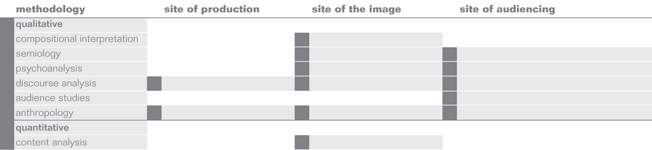
A methodology can be defined as a series of theories, approaches and processes that direct a research in a specific field of study. 'There remain remarkably few guides to possible methods of interpreting visual materials, and even fewer explanations of how to do those methods, despite the huge amount of academic work currently being published on things visual'.[17] Pre- existing guides for visual methodologies may be divided roughly into qualitative and quantitative methods. Some of the common qualitative visual methodologies are compositional interpretation, semiology, psychoanalysis, discourse analysis, audience studies and anthropology. In quantitative visual methodologies, content analysis is the most prominent. Each method has strengths and advantages in approaching particular aspects of an image, but not one method is exhaustive on its own accord. The following sections will give a very brief and selective account of each methodology, the visual aspects it exposes, and those that it leaves concealed figure 12. I will rely in my description on Gillian Rose's Visual Methodologies book, as it clearly defines the peripheries of each. Not all the methodologies will be based on a structured process, especially qualitative methods, as they depend mainly on philosophical discourse rather than scientific analysis. 0.1.0 Qualitative methodologies 0.1.1 Compositional interpretation This analysis lacks methodological explicitness and is mainly concerned with the study of the site of the image, and specifically with its compositional modality. It divides the aspects of a still image's composition into five criteria: The first is the content of an image in terms of tangible and intangible objects and concepts, the second is color, its hue, saturation and value, third is spatial organisation in terms of space within the image and viewing position to its spectator, fourth looks at light and its effect on color and spaces, and the last criterion is expressive content which comments on the combination between both the subject and visual form of the image. Evidently, these criteria change when the subject is moving image, as they need to question more complex and dimensional aspects related to the mis-en-scène, montage and sound. 0.1.2 Semiology This method looks at the notion of how images make meaning. It concentrates on the sites of the image and audiencing, because the study of semiotics is mainly concerned with reception. As in most qualitative methods, semiotic analysis does not have a clear workframe, but Rose suggests that an efficient way to apply semiology is by first identifying the signs in an image, then describing the nature of each sign, and finally recognizing the correlation between the different signs in the image. 0.1.3 Psychoanalysis The sites of the image and audiencing are the main areas that psychoanalysis approaches. It conveys the social difference and social power relations that an image induces in the viewer's subconsciousness. Although it serves as an informative analysis for films in particular, it is very much dominated by studies of sexuality above other social factors. 0.1.4 Discourse analysis There are two types of discourse analysis. The first pays more attention to discourse as articulated in visual images and verbal texts within the site of the image, while the second looks at discourse in association with the social modality in the sites of production and audiencing. When considered simultaneously, these two methods can give a clear understanding of all the sites of a graphic image. 0.1.5 Audience studies As the name implies, this methodology is involved with the site of audiencing. It studies the manner in which messages are encoded and then decoded when they reach the spectator. The main tools used in this study are interviewing audiences and arranging ethnographies so that the researcher observes the audience in the correct context where the image is being viewed. Audience studies is highly perceptive of the site of audiencing and its different modalities, but it does not attempt to look at the meanings within any of the other sites. 0.1.6 Anthropology This method pays careful attention to the material qualities of an image in addition to its exchange relations. It treats images as material objects that have a shape, volume, weight, texture, value, and mobility. Each one of these variables adds new meaning to the way an image is perceived. It is possible to allow anthropology to cover all the sites and modalities of an image if it is extended thoroughly. 0.2.0 Quantitative methodologies 0.2.1 Content analysis Unlike the previous methodologies, content analysis needs to follow very explicit procedures to be reliable. It is based on counting what is seen in the image, thus it is generally focused on the site of the image itself. The main procedure in content analysis is composed of four steps: the first is collecting a survey of images and verifying that it is representative, the second is devising categories for coding, then the third is coding the images in the survey, and the last is analysing the results. Its quantitative nature renders it reliable and replicable as it is based on numbers rather than subjective criticism. It can also reveal very empirical results when dealing with large amounts of images. These might be overwhelming when using qualitative methods of interpretation. 0.3.0 A methodology for socio-political graphics Three factors must always be taken into consideration when choosing a visual methodology. The first is finding the methodology that suits the sample of images under study, the second is verifying that it allows the investigation of the site(s) in question, and the third is assessing its feasibility 'within the limitations of time, costs, and staffing'.[18] Each one of these factors is considered in detail in order to put together a convenient methodology for analysing socio-political graphics. 0.3.1 Sample Over the years, socio-political graphics have taken many forms, from posters, newsletters, badges and T-shirts to movie trailers, websites, emails and multimedia messages. It was also discussed in the introduction that these graphics can touch on various social and political themes in a culture. This gives a wide and varied range of images that can possibly be investigated in a sample. Rose states that 'sample size depends on the amount of variation among all the relevant images. If there is absolutely no variation, a sample of one will be representative. If though there are a whole range of extreme variations, the sample size must be large enough to contain examples of those extremes'.[19] Thus, socio-political graphics need a methodology flexible enough to support a relatively large sample. In this case, content analysis would be the most appropriate methodology. However, due to its quantitative nature, it draws limitations when it comes to the sites at which meanings are made. 0.3.2 Sites Interpreting socio-political graphics is a highly sensitive cultural practice that relies heavily on the identity of the commissioner, the designer, the theme that is being communicated and how this theme reaches the audience. Thus in analysing socio-political graphics, particular attention needs to be paid to each of the site of production, the site of the image and the site of audiencing. In this respect, content analysis is not sufficient on its own because it only focuses on the site of the image, so a combination of other methodologies must be followed to support it. Rose suggests that 'mixing one method with another is a useful strategy for widening the empirical focus of a research project'.[20] The two methodologies that cover the site of production are discourse analysis and anthropology, but since anthropology deals with images as objects of material value, this method will not be revealing significant information regarding socio-political graphics because unlike many paintings, they are not 'sold' and 'purchased'. For the site of audiencing, the most direct methods would be discourse analysis and audience studies. It would also be useful to include semiology for the site of the image because content analysis does not particularly look at the social modality. 0.3.3 Feasibility So far, five different methodologies may be used simultaneously to retrieve information from socio- political graphics. With such a wide range of possible methodologies, feasibility becomes an issue to consider. Bram Oppenheim[18] advises reducing the aims of the study if the means to carry it out are insufficient. For example, audience studies relies on ethnographies and this might not be feasible as socio-political graphics are constantly altering their site of audiencing. A campaign might be there one day, and disappear the next, so to re-create the site of audiencing and arrange ethnographies is over-ambitious, especially when almost the same value of information can be retrieved from discourse analysis. Another feasibility issue is that relying on three different qualitative methods to interpret large sample sizes may lead to a certain kind of bias. This is particularly problematic with socio-political graphics because a successful methodology needs to be replicable. The context of these graphics is ever- changing with the changes in political and social issues, thus analysis will most likely not be a one-off review, but a somewhat continuous process throughout a progression of months or possibly years. A successful solution would rely on qualitative methods at the initial stage, but then translate the findings into quantitative information that can be fed into a replicable system. Catherine Lutz and Jane Collins[21] argue that 'although at first blush it might appear counterproductive to reduce the rich material in any photograph to a small number of codes, quantification does not preclude or substitute for qualitative analysis… It does allow, however, discovery of patterns that are too subtle to be visible on casual inspection and protection against unconscious search…' Accordingly, a valid methodology for analysing socio-political graphics will apply qualitative fragments from discourse analysis for the sites of production and audiencing in addition to semiology for the site of the image, and subsequently transfer the answers into methodological steps similar to content analysis but without dealing only with the 'content' of the image. At the end of the methodology, qualitative analysis will be conveyed again to analyse the results. The upcoming chapters will discuss in detail the procedure of this 'revised' methodology: formulating the research question, building a survey, coding the graphics, mapping the database and finally, analysing the results to find answers to the original research question. Each procedure is concurrently applied to the case study: Lebanese socio-political graphics between January 2005 and September 2007. It should be noted that the methodology also makes use of Bram Oppenheim's[22] research design for the social sciences. However, since social science studies people and their behaviours rather than visual sociology, it seemed sensible to only adopt the research steps related to sampling, coding, and analysis. Furthermore, the methodology adopts Edward Tufte's[23] fundamental principles of analytical design at the mapping stage of the process. Before proceeding with the main content of this volume, I would like to quote Gillian Rose[24] on the limitation of methodologies: "The most exciting, startling, and perceptive critics of visual images don't in the end depend entirely on their sound methodology… They also depend on the pleasure, thrills, fascination, wonder, fear or revulsion of the person looking at the images… Successful interpretation depends on a passionate engagement with what you see. Use your methodology to discipline your passion, not to deaden it." |
||
|
|||
 |
<< Introduction | Methodology [2/3] >> Joanna Choukeir
|
||
|
©////o/ |
||